
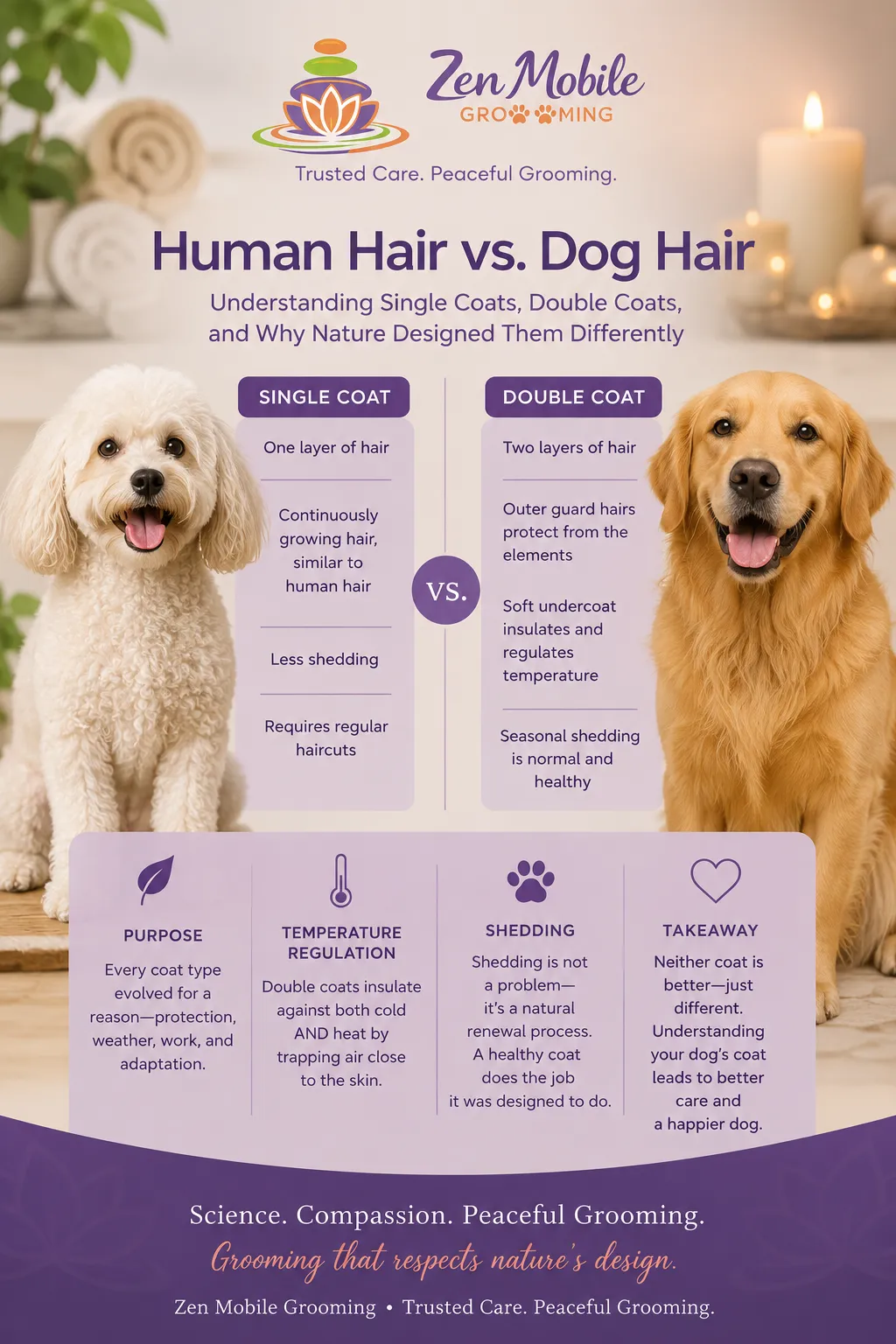
Human Hair Vs Dog Hair
Human Hair vs. Dog Hair: Understanding Single Coats, Double Coats, and Why Nature Designed Them Differently
Have you ever wondered why your dog sheds so much while your own hair seems to grow continuously?
Or why some dogs need frequent haircuts while others never need one at all?
The answer lies in a fascinating combination of biology, evolution, and purpose. While human hair and dog hair may appear similar at first glance, they serve very different functions and have evolved to meet very different needs.
Human Hair vs. Dog Hair: What's the Difference?
Both human hair and dog hair are made primarily of keratin, the same protein found in nails and claws. However, that's where many of the similarities end.
Human hair grows continuously and spends years in its active growth phase. This allows people to grow long hair that may continue growing for several years before naturally shedding.
Dog hair, on the other hand, follows a much shorter growth cycle. Many breeds experience periods of growth, rest, shedding, and replacement. This cycle helps dogs adapt to seasonal changes and maintain a healthy coat.
In simple terms:
Human hair is designed primarily for protection and temperature regulation, but continues growing almost indefinitely.
Dog hair is designed to provide insulation, weather protection, camouflage, and environmental adaptation.
What Is a Single Coat?
Single-coated dogs have only one layer of hair.
Breeds such as Poodles, Maltese, Yorkshire Terriers, and Shih Tzus are common examples.
Because they lack a dense insulating undercoat, these dogs tend to shed less than double-coated breeds. Their hair often grows continuously, much like human hair, which is why regular haircuts are necessary.
Single coats offer several advantages:
Reduced shedding
Easier visibility of skin issues
Softer texture
Continuous growth
However, because they lack the extra insulation of an undercoat, they may be more sensitive to temperature extremes.
What Is a Double Coat?
Double-coated dogs have two distinct layers of fur that work together.
The outer coat, known as guard hairs, consists of longer, coarser hairs that repel dirt, moisture, and environmental debris.
Beneath that is a dense undercoat made up of soft, fluffy hairs that trap air and regulate temperature.
Common double-coated breeds include:
Golden Retrievers
German Shepherds
Huskies
Australian Shepherds
Bernese Mountain Dogs
Labrador Retrievers
Pomeranians
This two-layer system acts much like a high-performance outdoor jacket.
The outer layer blocks wind and moisture.
The inner layer provides insulation.
Why Do Double-Coated Dogs Shed So Much?
The undercoat naturally sheds and renews itself throughout the year, with many breeds experiencing heavier seasonal shedding periods commonly referred to as "blowing coat."
This process is influenced by daylight length, temperature changes, hormones, and genetics.
While many owners assume shedding is a problem, shedding is actually evidence that the coat is functioning as nature intended.
The body is simply replacing old insulation with new insulation.
Does a Double Coat Keep Dogs Cool?
Surprisingly, yes.
Many people assume thick fur makes dogs hotter during summer, but the opposite is often true.
A healthy double coat acts as natural climate control by trapping pockets of air near the skin. These air pockets help insulate against both cold winter temperatures and summer heat.
Think of it like the insulation in a home.
The same insulation that helps keep heat inside during winter also helps keep excessive heat outside during summer.
This is one reason many veterinarians and grooming professionals caution against shaving most double-coated breeds unless medically necessary.
Removing the coat can interfere with the dog's natural ability to regulate temperature and may even increase the risk of sunburn and skin damage.
Evolution Designed Every Coat for a Purpose
Thousands of years of evolution shaped dog coats based on the environments where different breeds developed.
Northern breeds evolved dense double coats to survive harsh winters.
Water dogs developed coats that protected them from cold water.
Companion breeds often developed continuously growing hair that required less seasonal shedding.
Each coat type tells a story about the work, climate, and purpose for which a breed was originally developed.
The Takeaway
Neither single coats nor double coats are better.
They are simply different solutions to different environmental challenges.
A single-coated dog relies on continuously growing hair that requires regular maintenance.
A double-coated dog relies on a sophisticated two-layer insulation system that sheds and renews itself naturally.
Understanding how your dog's coat works helps you better appreciate one of nature's most remarkable examples of biological engineering.
The next time you find dog hair on your couch or schedule a haircut for your Poodle, remember: your dog's coat is doing exactly what it was designed to do.
